Pusan National University and PCENT Develop 100% Ammonia-Fired Burner That Cuts Three Emissions at Once
1MWt performance test at KEPCO Research Institute confirms stable combustion · Formation of NOx, N₂O and unburned ammonia suppressed · Product line to expand for ships, ports and power plants, with testing and certification standards in the works
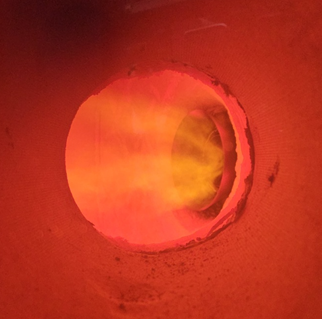
Pusan National University and technology commercialization company PCENT have developed a burner that uses ammonia as its only fuel.
By reducing nitrogen oxides, nitrous oxide and unburned ammonia at the same time, the key challenges of ammonia combustion, the burner raises the prospect of application in ships and power generation facilities.
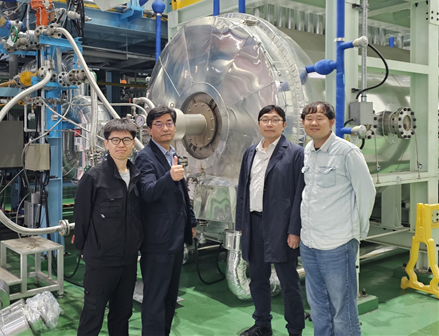
The Clean Thermal Power Energy Research Institute (PCERI) at Pusan National University, led by Professor Chung Hwan Jeon of the School of Mechanical Engineering, and PCENT (CEO Byeong Hwa Lee) announced that they have verified the performance of the 1MW-class ammonia-fired burner “P-NH3 BNR” through performance tests at the KEPCO Research Institute.
Ammonia emits no carbon dioxide when burned, making it attractive as a carbon-free fuel. However, its slow burning velocity makes it difficult to keep the flame stable, and combustion produces nitrogen oxides (NOx) and nitrous oxide (N₂O), a potent greenhouse gas.
Unburned ammonia that escapes without fully combusting (NH₃ slip) must also be reduced, which has made commercialization difficult.
In this test, the burner recorded NOx emissions below 85 ppm at 6% oxygen.
Unburned ammonia and nitrous oxide were each measured below 5 ppm.
The research team explained that this is world-class performance, lowering all three emissions simultaneously while suppressing unburned fuel under 100% ammonia firing conditions.
Building on this result, PCERI and PCENT plan to expand their product lineup by capacity for marine, port, power generation and industrial applications.
Through further research, they will reduce NOx emissions even more, and work with classification societies and certification bodies to establish testing and certification standards for ammonia combustion equipment.
They will also pursue applications in a range of energy systems, including carbon-free boilers, distributed power generation and ammonia crackers, in cooperation with domestic power companies such as Korea Southern Power, KEPCO Engineering & Construction, marine equipment makers, Panasia and Hyosung Heavy Industries.
“Ammonia-only combustion is a highly demanding technology that must secure flame stability while controlling NOx, N₂O and unburned ammonia at the same time,” said Director Chung Hwan Jeon. “This 1MWt performance test shows that the university’s core technology has reached a level where it can enter real industrial sites through a company.”
“The burner is a common core component across carbon-free boilers, power generation and crackers,” said Byeong Hwa Lee, CEO of PCENT and a research professor at Pusan National University. “We will expand our product family by capacity and, based on performance data, take the lead in establishing testing and certification standards.”
In Busan, a hub for shipbuilding, marine equipment and port industries, the technology is expected to support the decarbonization of eco-friendly ships and ports. “It will lay the groundwork for Busan to leap forward as a center for ammonia bunkering and eco-friendly marine equipment,” said Dr. Ha-yong Jang of the Busan Development Institute.
Certification cooperation for field deployment is also underway. “Ammonia-fueled equipment must be certified to objectively prove its safety and emission performance,” said Dr. In-cheol Jeong of the Korean Register, adding that the organization will cooperate in building a certification system to support domestic equipment makers’ overseas expansion.
“Auxiliary heat sources such as marine boilers also need to go carbon-free,” said Min Kim, team leader at the Korea Marine Equipment Research Institute. “Securing domestic core equipment that can convert even boilers to ammonia will strengthen the competitiveness of the marine equipment industry.”
Source: Electimes (전기신문)